CTA A/B Test Template: Outcome vs Action Copy
A CTA A/B test template for comparing outcome-focused copy ("Get more pipeline") against action-focused copy ("Start trial") on the same button. The test isolates copy as the cause of any click-through difference, with downstream funnel guardrails so a higher click-through rate does not silently degrade trial-to-paid conversion.
The two highest-impact mistakes on CTAs are mismatching copy to the searcher's job-to-be-done, and optimizing for clicks without tracking what happens after the click. This template addresses both.
Copy the template
Use it in Notion, a Google Doc, or wherever your team already works.
# CTA A/B Test: Outcome vs Action Copy

## Hypothesis
Because [observation about CTR or post-click intent], we will change the CTA from action-focused ("Start trial") to outcome-focused ("Get more pipeline"), and expect click-through rate to lift for [audience]. We will ship if CTR lifts at p < 0.05 with no more than 5% relative drop in trial-to-paid.

## Variants
- Control (A): Action-focused copy ("Start trial").
- Variant (B): Outcome-focused copy ("Get more pipeline").

## Metrics
- Primary: Click-through rate on the CTA.
- Guardrails: post-click bounce, Day-1 trial activation, trial-to-paid conversion, 30-day LTV per variant.

## Math
- Sample size: ~1,600 clicks per variant for 10% relative effect, 80% power, 95% confidence, 3% baseline CTR.
- Duration: 2-3 weeks or until sample size reached.

## Common failure to avoid
Calling the test on CTR alone. Cuter copy lifts clicks while dropping qualified trials.
The variants
Action-focused copy describing what the user does.
Example: Start trial
Outcome-focused copy describing the result the user wants.
Example: Get more pipeline
Metrics, math, and success criteria
Click-through rate on the CTA.
Post-click bounce rate, Day-1 trial activation, trial-to-paid conversion, 30-day LTV per variant.
About 1,600 clicks per variant to detect a 10 percent relative effect at 80 percent power and 95 percent confidence on a 3 percent baseline click-through rate. Adjust upward for smaller effects.
Statistically significant CTR lift at p < 0.05 with no more than 5 percent relative degradation in trial-to-paid conversion.
Two to three weeks, or until the predetermined sample size is reached, whichever is longer.
Expected outcome range
In B2B SaaS, CTA copy-only tests that win typically lift CTR by 5 to 20 percent. Flat is the more common result, and the structural learning still pays back.
Common failure mode
Treating CTR as the only metric. Cuter copy often lifts CTR while dropping qualified trials, because broader, vaguer language attracts users who never had real intent.
What this unlocks next
- If outcome copy wins, test the same outcome framing on the hero headline and the trial-confirmation screen for compounding lift.
- If outcome copy loses, the issue is likely upstream message-market fit. Run the landing-page positioning test next.
- Either result sharpens the Confidence score on related copy tests still in the backlog.
Running this template manually vs in GrowthLab
| Step | Manual (spreadsheet) | In GrowthLab |
|---|---|---|
| Draft variants | Brainstorm CTA copy from scratch in a doc, often skip the underlying observation and audience. | AI drafts outcome-focused and action-focused variants from your product context, with observation and audience pre-filled. |
| Prioritize | Argue about which CTA test should run first in a Slack thread. | ICE pre-scored at Impact 7, Confidence 7, Ease 8. Reranks live as the backlog grows. |
| Run and track | Track CTR in a spreadsheet, forget to wire guardrails like trial-to-paid. | Primary metric and the four guardrails are wired by default. Results update inline. |
| Capture the learning | Result lives in someone's notebook until they leave. | ROTI is computed at conclusion. The learning is stored in a searchable library that the next CTA test inherits. |
Inside GrowthLab
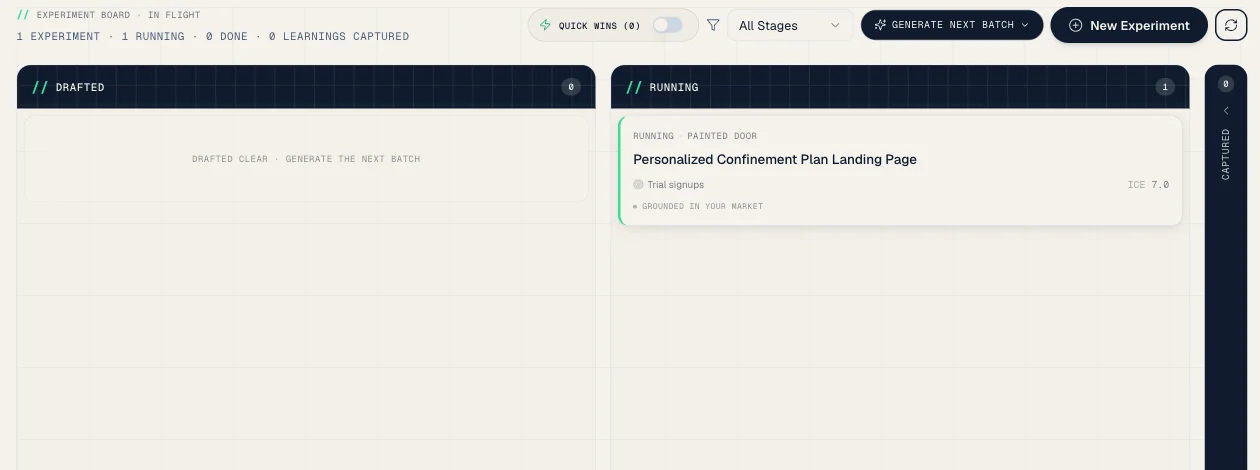
Inside GrowthLab the template loads with both variants pre-named, ICE pre-scored (Impact 7, Confidence 7, Ease 8), and primary plus guardrail metrics already wired. ROTI is computed at conclusion and the learning is stored in a searchable library, so the next CTA test inherits the prior.
Frequently asked questions
How long should a CTA A/B test run?
Run until you reach the predetermined sample size and cover at least one full business cycle. Stopping the moment significance flickers inflates false positives. For most B2B traffic, two to three weeks per variant is realistic.
What sample size do I need for a CTA test?
Roughly 1,600 clicks per variant to detect a 10 percent relative lift on a 3 percent baseline click-through rate at 95 percent confidence. Smaller effects need larger samples, so size the test before you launch.
Why track trial-to-paid as a guardrail on a CTA test?
Vague or aspirational copy can lift CTR by attracting low-intent users who never had buying motion. Tracking trial-to-paid catches the case where the variant looks like a win on clicks but drops paid conversion downstream.
Go deeper
- What is an A/B test
- What is an experiment hypothesis
- What is ICE scoring
- Experiment prioritization guide
About GrowthLab
GrowthLab is an experiment management tool where AI drafts the hypotheses, ICE and ROTI prioritize them, and every learning compounds into the next batch.
