Growth Experimentation: The 2026 Ultimate Guide
The complete guide to growth experimentation: the loop, how to write hypotheses, how to prioritize with ICE and ROTI, and how to turn a guide into a running program.
    <h1>The Complete Guide to Growth Experimentation in 2026</h1>

    <h2>Understanding Growth Experimentation in 2026</h2>
    <p>Growth experimentation is your structured approach to testing new ideas, validating assumptions, and making data-driven decisions that drive measurable business results. Rather than relying on intuition or copying competitors, it's a systematic approach involving developing hypotheses about what will drive growth, designing and running experiments to test those hypotheses, and analyzing results to make informed decisions.</p>

    <p>In 2026, the experimentation landscape has evolved significantly. AI is moving from experimentation to scaled deployment across enterprises and industries, fundamentally changing how growth teams operate. Modern experimentation platforms now function as AI thinking partners rather than simple testing tools, helping you generate quality experiment ideas and design rigorous tests faster than ever.</p>

    <h2>Why Growth Experimentation Matters More Than Ever</h2>
    <p>The alternative to systematic testing creates serious risks for your business. Guessing, copying competitors, or chasing trends might occasionally produce wins, but they're not sustainable.</p>

    <p>Consider the scale at which leading companies experiment. If every Netflix member is on average in 20 experiments with three variants each, that's 3.5 billion Netflix experiences. This massive experimentation velocity drives continuous improvement and competitive advantage.</p>

    <p>Your experimentation program delivers three critical benefits:</p>

    <p><strong>Data-backed decisions:</strong> You replace gut feelings with solid evidence, making educated choices with higher probability of success.</p>

    <p><strong>Risk reduction:</strong> Experimentation allows you to test ideas on smaller scales, minimizing potential negative impact if changes underperform.</p>

    <p><strong>Continuous improvement:</strong> Each experiment generates knowledge, whether you see a win or loss. These insights compound over time, building institutional knowledge that accelerates future growth.</p>

    <h2>Building Your Growth Experimentation Framework</h2>
    <p>An experimentation framework is a structured approach to conducting experiments that serves as a roadmap for testing new ideas, evaluating hypotheses, and making data-driven decisions.</p>

    <p>Your framework needs six essential components:</p>
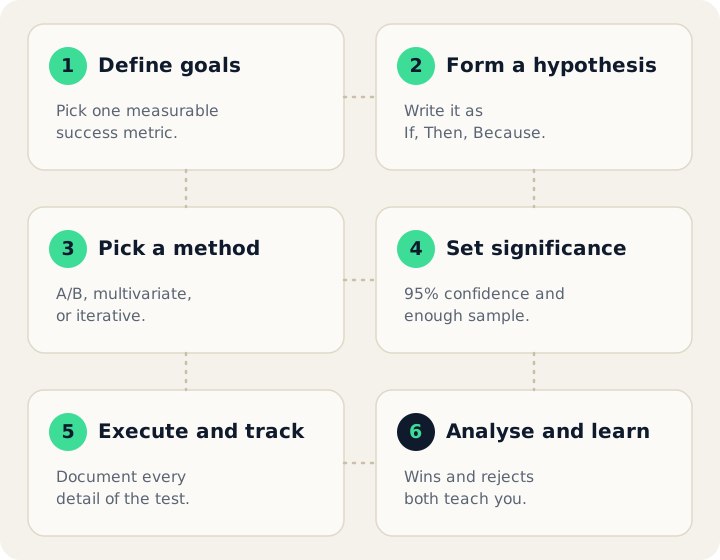
1. Define Clear Goals and Success Metrics
Start with specific, measurable objectives aligned with your business strategy. Instead of "increase conversions," aim for precision: "Increase trial-to-paid conversion rate by 15% within 90 days."
    <p>Set a SMART goal for your program, such as "Add an additional £10m in profit within the next 12 months." Defining a single metric of success is key to measuring experiment success or failure.</p>

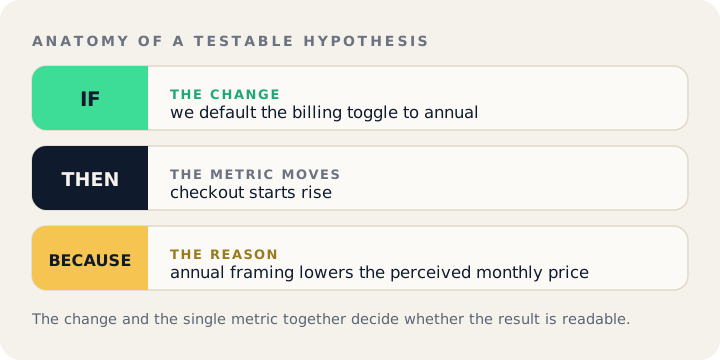
    <h3>2. Formulate Strong Hypotheses</h3>
    <p>In A/B testing, a hypothesis is an educated guess about what could improve performance, a prediction about the relationship between the element you're changing and the outcome you want to influence.</p>

    <p>Your hypothesis should follow this structure:</p>
    <ul>
        <li><strong>Problem identified:</strong> What specific issue are you addressing based on data?</li>
        <li><strong>Proposed solution:</strong> What change will you implement?</li>
        <li><strong>Expected outcome:</strong> How will this impact your key metric?</li>
        <li><strong>Rationale:</strong> Why do you believe this will work?</li>
    </ul>


        <p><strong>Example:</strong> "We've observed through session recordings that 65% of mobile users abandon our signup form at the email verification step. By implementing one-click social login, we expect to reduce signup abandonment by 25% because users prefer faster authentication methods."</p>


    <p>A good hypothesis is specific, testable, and based on research and data.</p>
3. Choose Your Testing Methodology
Your testing methodology determines how reliable and actionable your results will be. The three most common approaches in 2026:
    <p><strong>A/B Testing:</strong> Testing two versions of a product or feature with a single variable changed between them. This works best for small, specific changes like button colors, headline copy, or CTA placement.</p>

    <p><strong>Multivariate Testing:</strong> Testing multiple variables across multiple versions of a product or feature, such as different combinations of colors, layouts, and messaging to determine which combination performs best.</p>

    <p><strong>Iterative Testing:</strong> This dynamic approach unfolds in stages, allowing changes based on each step's results before moving to the next.</p>

    <h3>4. Determine Statistical Significance</h3>
    <p>You need sufficient sample size for reliable results. To choose a statistically significant sample, consider population size, confidence level, and margin of error.</p>

    <p>Most experimentation platforms use 95% confidence level as standard, meaning you can be 95% certain your results aren't due to chance.</p>

    <h3>5. Execute and Track Your Experiments</h3>
    <p>Precise execution separates successful experiments from wasted effort. Being as precise as possible in experiment description is essential, especially if engineers are involved.</p>

    <p>Document everything: hypothesis, variations, success criteria, segment details, start/end dates, and environmental factors that might influence results. Each growth experiment should build a knowledge repository documenting experiment details including hypotheses, variations, success criteria, metrics, and most importantly results and learnings.</p>

    <h3>6. Analyze Results and Extract Learnings</h3>
    <p>Analysis goes beyond declaring winners and losers. When people expect experiments to deliver lifts, they're goaling experiments incorrectly. Although getting wins feels nice, losses are more valuable because they show you where you held incorrect beliefs about your product or users.</p>

    <p>Your post-experiment analysis should answer:</p>
    <ul>
        <li>Did the variation reach statistical significance?</li>
        <li>What was the magnitude of impact on your primary metric?</li>
        <li>Were there unexpected impacts on secondary metrics?</li>
        <li>Which user segments responded differently?</li>
        <li>What customer insights did you uncover?</li>
        <li>How does this inform your next experiments?</li>
    </ul>

    <h2>Prioritizing Experiments with ICE Scoring</h2>
    <p>With dozens of potential experiments in your backlog, how do you decide which to run first? Enter the ICE scoring model.</p>

    <p>ICE scoring was created by Sean Ellis, the growth hacking pioneer who needed a fast way to prioritize rapid experiments. ICE is now used for both growth experiments and features prioritization.</p>
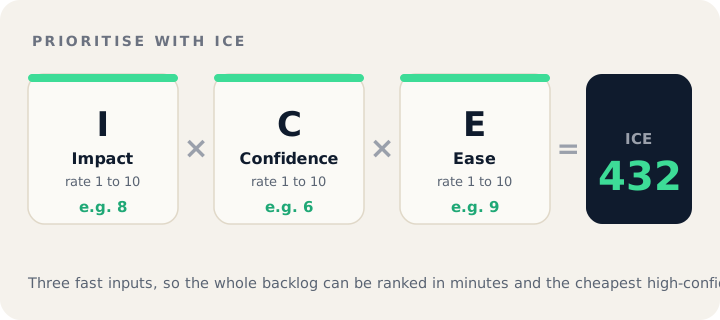
Understanding ICE Components
ICE calculates a score per idea with three components: Impact demonstrates how much your idea will positively affect the key metric you're trying to improve, Confidence shows how sure you are about your estimates, and Ease is about the easiness of implementation and resources required.
    <p>Each factor receives a score from 1-10, then you multiply them together for your final ICE score:</p>


        <p><strong>ICE Score = Impact × Confidence × Ease</strong></p>


    <p>Because ICE only requires three inputs, teams can rapidly calculate the ICE score for everything and make prioritization decisions accordingly.</p>

    <h3>How to Score Your Experiments</h3>
    <p><strong>Impact (1-10):</strong> How significantly will this move your north star metric if successful? A score of 10 means massive impact on your primary KPI, while 1 means minimal effect.</p>

    <p><strong>Confidence (1-10):</strong> How certain are you this will work? Base this on previous data, user research, competitor analysis, and team expertise. High confidence (8-10) comes from strong supporting evidence, while low confidence (1-3) represents educated guesses.</p>

    <p><strong>Ease (1-10):</strong> How simple is implementation? A score of 10 means you can launch in hours with minimal resources, while 1 indicates weeks of engineering work across multiple teams.</p>

    <h3>ICE Scoring Example</h3>


                Add trust badges above payment form
                6
                8
                9
                432


                Implement one-click checkout
                9
                7
                3
                189


                Test checkout button color
                3
                7
                10
                210


    <p>In this case, the trust badges experiment wins despite having lower potential impact than one-click checkout, because its high ease of implementation and confidence boost its overall score.</p>

    <h3>ICE Scoring Best Practices</h3>
    <ul>
        <li><strong>Focus on one goal at a time:</strong> When you focus on the 3 vital metrics of the ICE framework, proceed with one clearly defined goal at a time.</li>
        <li><strong>Document your scores:</strong> Documenting ICE scores and test results helps you keep track of all records, acting as a reference point for grading future ICE scores.</li>
        <li><strong>Balance quick wins with big swings:</strong> Keep an absolute minimum of 20% of your experiments dedicated to big swings while other ideas might be safer bets.</li>
        <li><strong>Use team consensus:</strong> ICE works best when multiple team members score independently, then discuss significant discrepancies to reach alignment.</li>
    </ul>

    <h2>Growth Experimentation Comparison: Traditional vs. Modern Approaches</h2>


                Idea Generation
                ✓ Manual brainstorming
                ✓ Manual + AI suggestions
                ✓ AI-guided 4 modes (Safe Bets, Bold Bets, Copy What Works, First Principles)


                Hypothesis Validation
                ✓ Basic templates
                ✓ Structured frameworks
                ✓ Real-time feedback on clarity, metrics, testability


                Prioritization
                ✓ Gut feeling or simple scoring
                ✓ ICE/RICE scoring
                ✓ ICE scoring with transparent AI rationale


                Experiment Tracking
                ✓ Spreadsheets
                ✓ Project management tools
                ✓ Automated tracking with AI-generated summaries


                Knowledge Management
                ✗ Often lost
                ✓ Documented in wikis
                ✓ Converted to reusable playbooks automatically


                Time to Launch
                ✗ 1-2 weeks average
                ✓ 3-7 days
                ✓ ~2 days average


                Learning Capture
                ✗ Inconsistent
                ✓ Manual documentation
                ✓ AI-assisted insight extraction


    <h2>Advanced Experimentation Tactics for 2026</h2>

    <h3>Leverage AI for Faster Ideation</h3>
    <p>The experimentation landscape has shifted dramatically with AI integration. Modern platforms like Growth Experiments now offer AI-guided ideation across four strategic modes:</p>

    <ul>
        <li><strong>Safe Bets:</strong> Proven tactics from your industry with high win probability</li>
        <li><strong>Bold Bets:</strong> Innovative approaches that could deliver breakthrough results</li>
        <li><strong>Copy What Works:</strong> Validated strategies from leading companies in other verticals</li>
        <li><strong>First Principles:</strong> Fundamental rethinking of your growth challenges</li>
    </ul>

    <p>This AI assistance doesn't replace human judgment, it accelerates your ideation process by surfacing relevant patterns from thousands of successful experiments across industries.</p>

    <h3>Build User Segmentation Into Every Test</h3>
    <p>Your customers aren't one homogenous group. Most SaaS companies cater to a diverse user base with different needs, preferences, and behaviors. Segmentation allows you to tailor experiments to specific user groups, making it simpler to uncover insights relevant to each segment.</p>

    <p>Segment your experiments by user acquisition channel, product usage frequency, customer lifetime value tier, geographic location, device type, and funnel stage.</p>


        <p>By testing and measuring across segments, teams have delivered a 9% sales lift among price-sensitive shoppers, a 36% increase from loyal buyers, and a threefold boost in brand consideration.</p>


    <h3>Run Experiments Continuously, Not Occasionally</h3>
    <p>If your experimentation business strategy relies on launching just one growth experiment and expecting that to make the difference, it'll fail. You should conduct experiments continuously with a structured plan setting out when experiments should be carried out to keep momentum up.</p>

    <p>Leading growth teams now operate in sprint cycles, typically running 5-15 experiments simultaneously at different funnel stages. This velocity creates a compounding learning effect where insights from one experiment inform hypotheses for the next.</p>

    <h3>Test Duration and Timing Strategies</h3>
    <p>Test scheduling is one of the most crucial A/B testing best practices. Most online businesses have predictable peak times as well as slower periods. Testing traffic over Black Friday and comparing it to regular Tuesday in February won't give reliable data.</p>

    <p>The amount of time required for a reliable test varies depending on factors like conversion rates and how much traffic your website gets. A good testing tool tells you when you've gathered enough data to draw a reliable conclusion.</p>

    <p>Run tests for complete business cycles (typically 1-4 weeks) to account for weekly patterns in user behavior.</p>

    <h2>Growth Experimentation Tools Comparison: Key Features</h2>


                Testing Platform
                ✓ A/B and multivariate testing<br>✓ Statistical significance calculation<br>✓ Traffic allocation
                ✓ Multi-armed bandit<br>✓ Server-side testing<br>✓ Feature flagging
                ✓ Fast 2-day idea-to-launch<br>✓ AI challenges weak hypotheses<br>✓ Explainable AI outputs


                Analytics
                ✓ Conversion tracking<br>✓ Segment analysis<br>✓ Statistical reports
                ✓ Heatmaps<br>✓ Session recordings<br>✓ Funnel visualization
                ✓ AI-generated experiment summaries<br>✓ Stakeholder-ready narratives<br>✓ Cross-experiment learning


                Collaboration
                ✓ Team member access<br>✓ Approval workflows<br>✓ Experiment history
                ✓ Comments/annotations<br>✓ Slack integration<br>✓ Version control
                ✓ Shared views with roles<br>✓ Real-time collaboration<br>✓ Knowledge engine converts experiments to playbooks


    <p>According to the 2024 Marketing Technology Landscape report, the number of tools in the optimization, personalization, and testing segment jumped from 230 to 271 in just one year. The global A/B testing tools market will grow at a CAGR of 11.5 percent through 2032.</p>

    <h2>Common Experimentation Mistakes and How to Avoid Them</h2>

    <h3>Mistake 1: Testing Without Clear Hypotheses</h3>
    <p>When teams say "We have a low pricing-to-checkout conversion rate, so let's optimize the pricing page" and test different colors and layouts, the experimentation isn't framed around the customer problem. If the team had talked to customers, they might have found that it's not the pricing page's UX stopping them from upgrading, but rather they may not feel ready to buy yet.</p>

    <p><strong>Solution:</strong> Always start with customer research. Use session recordings, user interviews, and behavioral data to understand why users behave as they do, then form hypotheses addressing those root causes.</p>

    <h3>Mistake 2: Ending Tests Too Early</h3>
    <p>The pressure to move fast can lead teams to call winners before reaching statistical significance. This creates false positives that waste resources on ineffective changes.</p>

    <p><strong>Solution:</strong> Set your significance threshold before starting (typically 95% confidence with 80% statistical power) and wait until you reach it. Use duration calculators to estimate required runtime upfront.</p>

    <h3>Mistake 3: Ignoring External Factors</h3>
    <p>Tests running during product launches, major holidays, or PR events can produce skewed results that don't represent normal user behavior.</p>

    <p><strong>Solution:</strong> You should take care of seasonal influences while setting up a test, as off seasons or irregular days might not be the best time to run a test. Collect information about your product from customers before setting up any big test.</p>

    <h3>Mistake 4: Testing Too Many Variables Simultaneously</h3>
    <p>When you change headlines, images, CTAs, and layout all at once, you can't determine which element drove the result.</p>

    <p><strong>Solution:</strong> Test one variable at a time in A/B tests, or use proper multivariate testing methodology with sufficient traffic to isolate individual element effects.</p>

    <h3>Mistake 5: Not Documenting Learnings</h3>
    <p>"Log the hypothesis, outcome, and insight for every test, otherwise, you'll just repeat your mistakes. I keep a central A/B test log with test details and outcomes so I know what to do for my next campaign."</p>

    <p><strong>Solution:</strong> Create experiment documentation templates that capture hypothesis, methodology, results, insights, and recommended next steps. Make this knowledge accessible to your entire organization.</p>

    <h2>Building a Culture of Experimentation</h2>
    <p>Tools and frameworks mean nothing without the right organizational culture. Here's how to build experimentation into your company DNA:</p>

    <h3>Embrace Intelligent Failure</h3>
    <p>Fear of failure and being wrong stifles ideas and leads to teams shifting goalposts to demonstrate success. To encourage the right thinking, categorize experiments as "accepted" and "rejected" upon conclusion instead of "success" and "failure."</p>

    <p>Every experiment that reaches statistical significance provides value, regardless of whether it supports or rejects your hypothesis. Rejected hypotheses are especially valuable because they reveal incorrect assumptions you can now correct.</p>

    <h3>Establish Clear Authority and Budget</h3>
    <p>One major barrier in larger organizations is red-tape and fear of making decisions without coverage from "above," which slows down the experimentation process significantly. The growth team should have clearly defined authority and testing budget without return expectations within which they can run experiments.</p>

    <h3>Foster Cross-Functional Collaboration</h3>
    <p>A growth culture should exist across all areas of the business from product and engineering through to sales and customer service, but the growth team needs to have the authority and capability to prioritize and implement experiments across the business.</p>

    <h3>Prioritize Learning Velocity</h3>
    <p>Speed is fundamental as the faster you are able to validate or reject your hypotheses, the faster you'll generate the insight to drive further growth.</p>

    <p>Modern platforms have dramatically accelerated this cycle. Growth Experiments is built to shorten the path from idea to launch and help teams run more experiments without losing rigor.</p>
Growth Experiment Examples by Funnel Stage
The fastest way to fill a backlog is to borrow proven experiment shapes and adapt them to your product. The examples below are organized by funnel stage so you can see what a testable idea looks like at each step of the journey. Each one pairs a single change with the one metric it is meant to move, which is the discipline that separates a real experiment from a redesign.
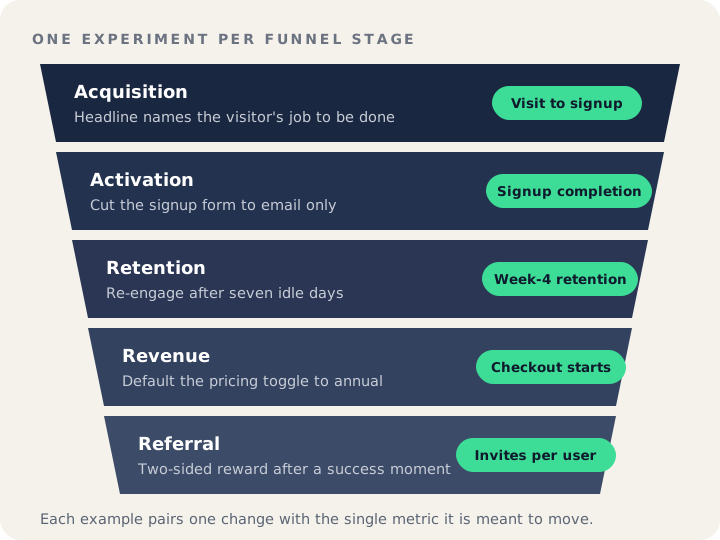
| Funnel stage | Example experiment | Primary metric it moves |
|---|---|---|
| Acquisition | Replace a generic homepage headline with one that names the visitor's job to be done | Visit-to-signup rate |
| Activation | Cut the signup form to email only and defer profile fields to the first session | Signup completion rate |
| Activation | Add a three-step onboarding checklist that ends at the product's first clear value moment | Day-1 activation rate |
| Retention | Trigger a re-engagement email when a user has not returned for seven days | Week-4 retention |
| Revenue | Default the pricing toggle to annual billing with the monthly price shown alongside | Checkout start rate |
| Revenue | Add trust badges and a money-back line directly above the payment button | Checkout completion rate |
| Referral | Offer a two-sided reward and surface the invite prompt right after a success moment | Invites sent per active user |
Notice that none of these examples is "redesign the page." Each names one change and one metric, which is what makes the result readable. Before you run any of them, write the idea as an If, Then, Because hypothesis and score it so the cheapest high-confidence tests rise to the top. The acquisition and referral examples above work best when they feed a repeatable growth loop rather than a one-off campaign, and if you sell software the SaaS experiments guide goes deeper on activation and revenue tests for that model.
A Growth Experiment Template You Can Copy
A growth experiment template is a fixed set of fields you complete before every test so each one stays comparable, reviewable, and worth repeating. The version below uses eight fields. Copy it into your backlog tool and fill it in for every idea before you build anything.
The eight fields every experiment needs
| Field | What to write | Example |
|---|---|---|
| Experiment name | A short, searchable label | Annual plan default on the pricing page |
| Funnel stage | Where in the journey the test sits | Monetization |
| Hypothesis | One If, Then, Because sentence | If we default the billing toggle to annual, then checkout starts will rise, because annual framing lowers the perceived monthly price |
| Primary metric | The single number that decides the result | Checkout start rate |
| Guardrail metric | What must not get worse | Refund rate |
| ICE score | Impact, Confidence, and Ease, each rated 1 to 10 | 8, 6, 9 |
| Sample and duration | Traffic needed and how long to run | About 12,000 sessions, roughly two weeks |
| Result and learning | Completed after the test ends | Rejected: the annual default reduced checkout starts, so keep the monthly default |
The hypothesis field is the one most teams get wrong. Writing it as If, Then, Because forces you to name the change, the metric you expect to move, and the reason you believe it will move. A vague line such as "redesign the pricing page" gives you nothing to measure. A structured line tells you exactly what counts as a win before the test starts.
How to use the template across the program
Complete fields one through seven before any build work begins. Score the idea with ICE, then rank it against everything else in your backlog using the same method, which is covered in the experiment prioritization guide. Choose a primary metric that ladders up to your north star metric rather than a vanity number, so a win on the test is a win for the business. When the test ends, complete field eight with the outcome and the insight, then file it so your next hypothesis starts from what you already learned.
    <h2>Frequently Asked Questions</h2>


        How many experiments should we run simultaneously?
        <p>This depends on your traffic volume and organizational capacity. Start with 2-3 experiments across different funnel stages, ensuring each receives sufficient traffic for statistical significance. As your process matures, scale to 5-15 concurrent tests across various customer journey stages.</p>


        What's a good experiment win rate?
        <p>Industry benchmarks suggest 20-30% of experiments produce positive results. If you're winning much more than 30%, you're likely playing too safe with obvious optimizations. Losses are more valuable than wins because they show you where you held incorrect beliefs about your product or users.</p>


        How do we get stakeholder buy-in for experimentation?
        <p>Start small with low-risk, high-visibility experiments that demonstrate quick wins. Document your methodology and results transparently. Frame experiments as reducing risk rather than slowing deployment. Modern tools like Growth Experiments generate stakeholder-ready reports automatically, making it easier to communicate results and learnings.</p>


        Should we test incremental changes or big swings?
        <p>Both. Keep an absolute minimum of 20% of your experiments dedicated to big swings that might have huge impact, while other ideas might be safer bets. Incremental optimizations compound over time, while occasional breakthrough experiments can unlock step-function growth.</p>


        How long should we run experiments?
        <p>The amount of time required for a reliable test will vary depending on factors like your conversion rates and how much traffic your website gets. A good testing tool tells you when you've gathered enough data to draw a reliable conclusion. Minimum runtime is typically 1-2 weeks to account for weekly user behavior patterns, with most experiments running 2-4 weeks.</p>


        What if we don't have enough traffic for statistically significant results?
        <p>Consider testing higher-traffic funnel stages, extending test duration, or accepting larger minimum detectable effects. For low-traffic sites, focus on qualitative research methods like user testing and customer interviews to supplement smaller quantitative tests.</p>


        How do we avoid analysis paralysis with ICE scoring?
        <p>Remember that the ICE Framework isn't a science. If in the end you or your team feels better about the second-highest scored idea versus the highest-scored one, simply go with it, as team enthusiasm and stakeholder management are also important. Use ICE to create relative prioritization, not absolute truth.</p>
What should a growth experiment template include?
At minimum, include a name, the funnel stage, an If, Then, Because hypothesis, one primary metric, a guardrail metric, an ICE score, the sample size and duration, and a result-and-learning field you complete after the test. The hypothesis and the single primary metric matter most, because together they decide whether the result is readable. Keep the template identical for every test so results stay comparable over time.
<h4 class="faq-question">What are some good growth experiment examples to start with?</h4>
Start where your funnel leaks most. Common high-intent examples include shortening the signup form to email only for activation, defaulting the pricing toggle to annual billing for revenue, triggering a re-engagement email after seven days of inactivity for retention, and adding a two-sided reward after a success moment for referral. Pick one stage, write the idea as an If, Then, Because hypothesis, and score it before you build so the cheapest high-confidence test runs first.
Conclusion
Growth experimentation in 2026 has evolved far beyond simple A/B testing into a sophisticated discipline that combines rigorous methodology, AI-assisted insights, and organizational culture change. The companies winning in today's competitive landscape aren't guessing their way to growth, they're building systematic frameworks that generate compound learning over time.
<p>Growth experimentation is the key to sustained business success because it allows companies to test, learn, an</p>
From guide to running program
Reading about growth experimentation is the easy part. The teams that compound are the ones who turn it into a weekly system: a ranked backlog, a scoring method that decides what to run first, and a learning capture layer so every result sharpens the next hypothesis. The bridge from theory to practice is prioritization. Most programs stall because they score ideas on ICE alone and quietly over-rank slow, high-impact builds. Pairing ICE with ROTI (Return On Time Invested) surfaces the fast, cheap tests that let you run the next experiment sooner, and that cadence is what actually moves the metric over a quarter.
To put this into motion: start from the ICE scoring guide to rank your backlog, use the growth experiment template to design each test with a structured hypothesis, and let the experiment database keep everything ranked by ICE, ROTI, and an AAA design self-score as you run it.
